Zati for specialist staffing & search
Staffing work stalls between people. Give it a team with owners
Between the client brief and the candidate's start date, a placement passes through documents, deadlines and half-remembered context. Independent staffing and search firms lose time in that gap. Zati gives you a workspace to define AI workers, assign them real responsibilities, inspect what they produce and decide what still needs a person.
The work that keeps slipping
A submission that goes out with a date nobody verified. An interview brief that arrives without the panel's actual questions. A start-date packet missing a document the client required. Each one is a handoff with no named owner, and each one lands on a recruiter who was not in the conversation.
The fix is a defined responsibility, a defined output and a defined decision point.
One handoff, three workers, one decision
Take interview coordination for a retained search. Inputs are the supplied availability, the client's interview instructions and the outstanding questions from earlier stages. You can configure a team like this:
- A research worker's assignment: gather the supplied availability and interview instructions, cite where each detail came from, and list what is missing.
- A drafting worker's assignment: assemble a coordination brief for the recruiter, with the schedule, the panel's stated focus and open questions kept visible.
- A reviewing worker's assignment: compare the brief against the client's instructions and flag anything the recruiter should confirm before it is sent.
- The human decision: the recruiter confirms the schedule with the panel and approves what the candidate is told.
The output is inspectable, the handoff is explicit, and the judgment stays with the person who owns the relationship.
Build the team around your firm
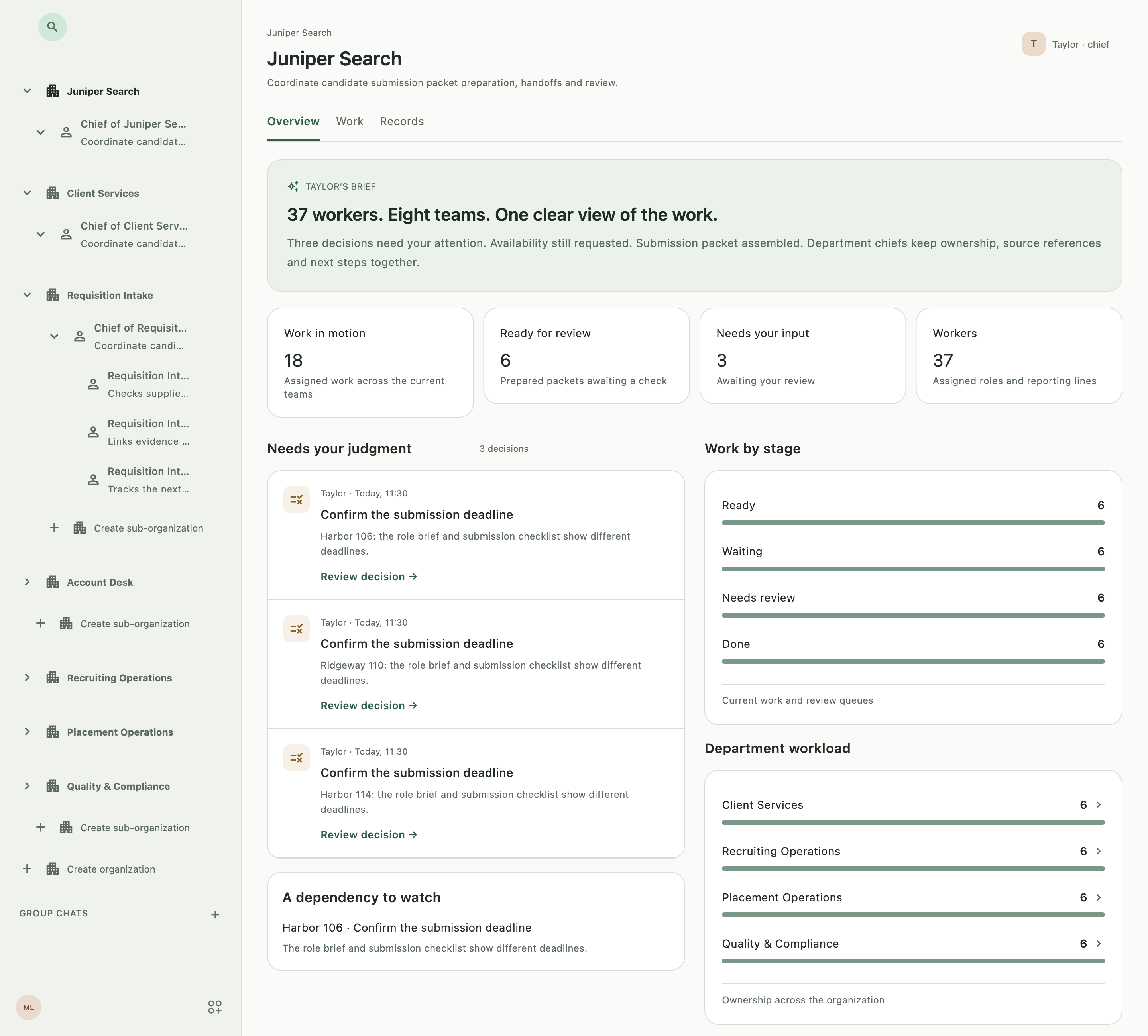
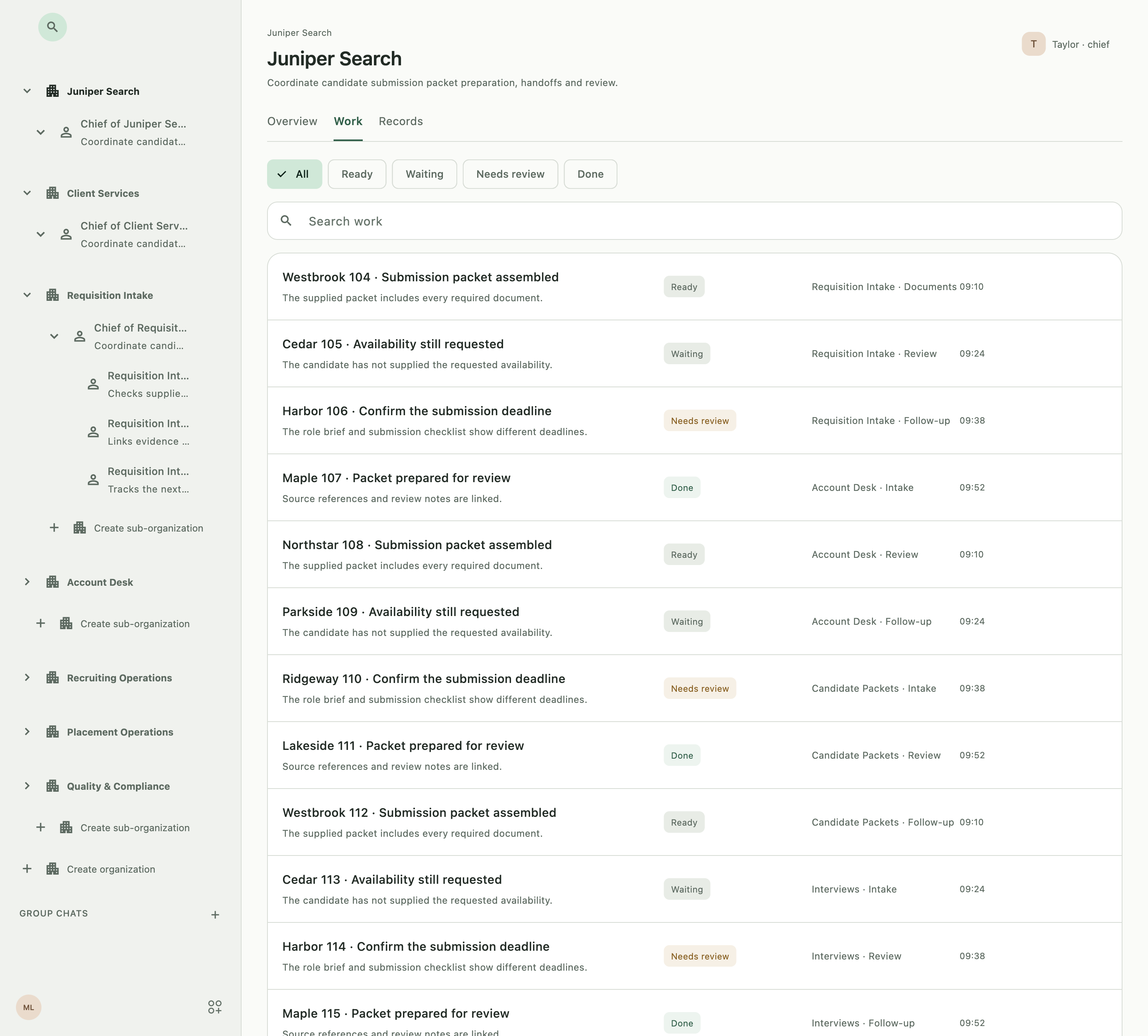
Keep workers, conversations, tasks and files in one organizational workspace. Name workers, set their instructions and skills, and give them reporting relationships that reflect your recruiting, client-service and placement structure. A small organization can begin with one handoff and expand where the adjacent work is useful.
Assigned work, review queues and next steps. Open the image for a full-size view.
Keep records, privacy and judgment in the right hands
Your ATS and CRM remain the owners of candidate, client and placement records, including the automation you already run. Supply only material authorized for the assignment. Any additional access depends on supported connections and the permissions you grant, and a reporting relationship alone does not widen candidate access.
Recruiters check factual accuracy, relevance and potentially biased wording before anything reaches a candidate or a client. Selection decisions remain human. Approve the exact message and its recipient before it leaves, and confirm onboarding conclusions through your established process.
Questions before you start
What does a first configuration look like?
One responsibility, a small set of named workers, a stated output standard and a review step. It is enough to test whether the work comes back usable.
Can it sit alongside our ATS and CRM?
Bring your current stack to the call. We will work through the connections, access and outputs your setup requires.
What do we need ready?
One recurring handoff, a sample of its inputs and the result your recruiter would sign off on. That is enough to scope a starting team.
Bring one handoff to the call
Choose the work that keeps slipping and bring it to a free 30-minute discovery conversation with David. We will map the workers, the review step and the decisions that stay with your people.